Showing posts with label Koo-Wee-Rup Swamp. Show all posts

Tuesday, February 26, 2013

Swamp Run February 24, 2013

The Historic Commercial Vehicle Club and the Trafalgar Truck Restorers Club held a joint run on Sunday, February 24 2013. We started opposite the old General Motors Factory at Dandenong, and travelled down the Princes Highway through to Berwick, up and over the Berwick hill, through to Beaconsfield and Officer, then we turned right, down Cardinia Road to Cardinia, onto Dalmore Road, which is the start of the Koo-Wee-Rup Swamp, onto the South Gippsland Highway. We stopped at the Swamp look-out tower which has great views across to French Island. It is right next to the Main Drain, which was dug to drain the Swamp. Work on the drain started in 1889 and the 16 miles to just south of Bunyip was completed by 1893. After that we went through Koo-Wee-Rup, Bayles and onto our place at Cora Lynn for lunch. Great day!


The view from the Swamp look-out tower. Click on the photos to enlarge them. The green and yellow do-nut van wasn't part of our run!

Below, all the trucks at our place.


Steve Camilleri - Commer Knocker. This model was the last of the Commer Knockers.


Adrian Hem - 1964 J-model Bedford.


Our 1974 1418 Benz.


Eric Shingles - 1974 1418 Benz.


An Amilcar - two views.


The Amilcar - view 2
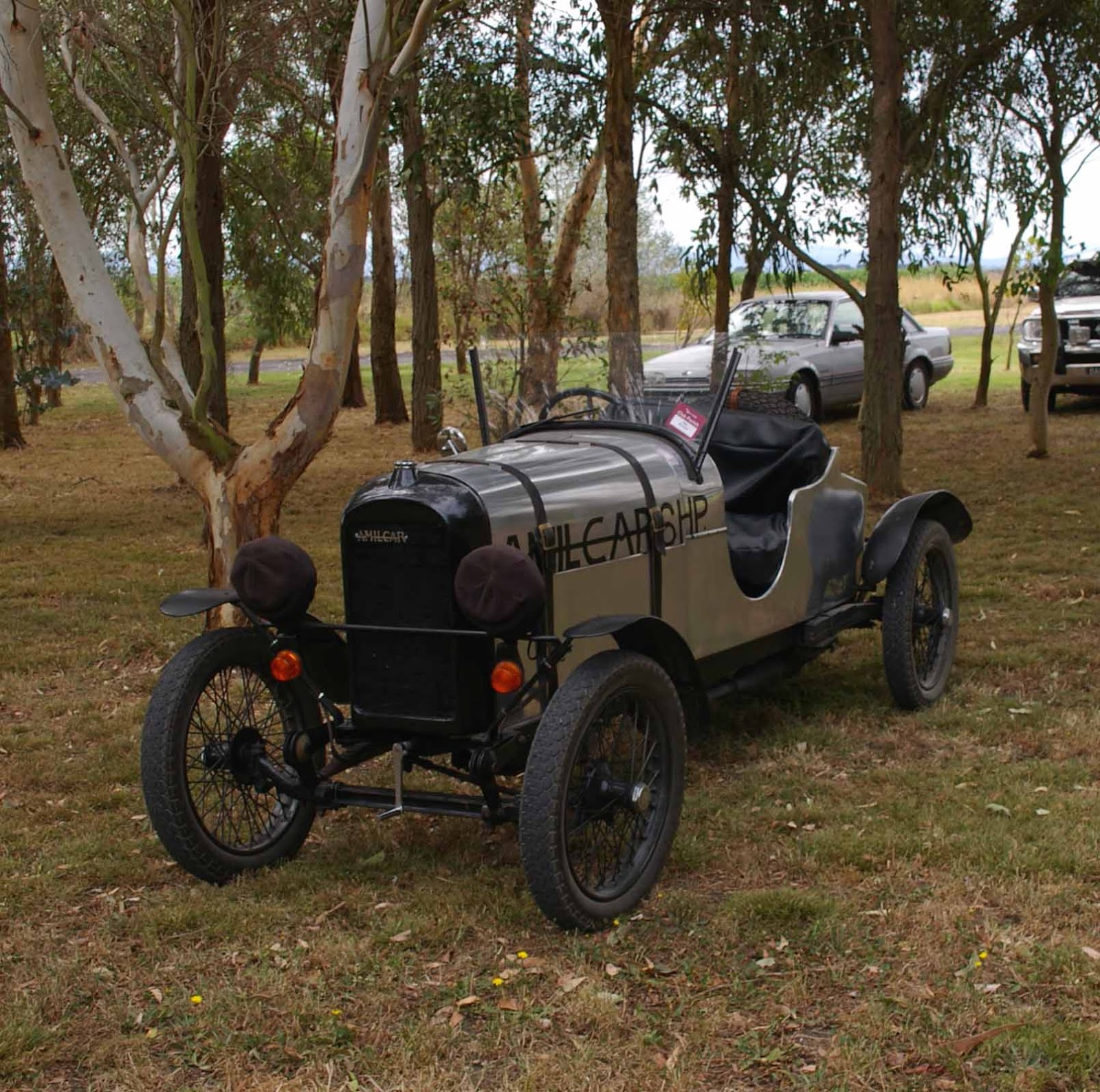

Another Amilcar. This one is owned by Lynn and Ray O'Halloran and the one shown above this is owned by Lynn's brother, Phillip. Great effort, coming all the way in such little cars!. Amilcars were made in France from 1921 to 1939. According to the book The complete encyclopedia of Motorcars, 1885 to the present, edited by G.N Georgano (Ebury Press, 1968) the Amilcar 'was the most famous and successful of all the sporting voiturettes that proliferated in France after World War One'. A voiturette is a miniature automobile.


Richard Christie - Ford F100.


John Gramlick - 1961 Commer Knocker.


Russell Marshall - 1941 Ford.


John Wright - 1981 International Acco.


Brian Dawes - Dodge


Max Devlin - 1928 Dodge.


Dave Horne - 1934 British Bedford. I did the trip with Dave in this truck.


Graham and Shirley Pollard - Austin 1800. John says they were jokingly called 'land crabs'


Our Volvo - 1976 N10 - the first of the N-series in Australia.


The 'working Volvo' - 2000 NH 12- the last of the N-series in Australia. This is ours as well.


Bill and Pat O'Halloran - 1975 Perkins powered Dodge.


Colin Hook - Transtar, ex U.S Air Force.


Jeff Johnston - F12 Volvo.


Daryl Lloyd - International Acco - all the way from Kinglake.


Graham and Heather Cameron - 1973 Inter D1210.
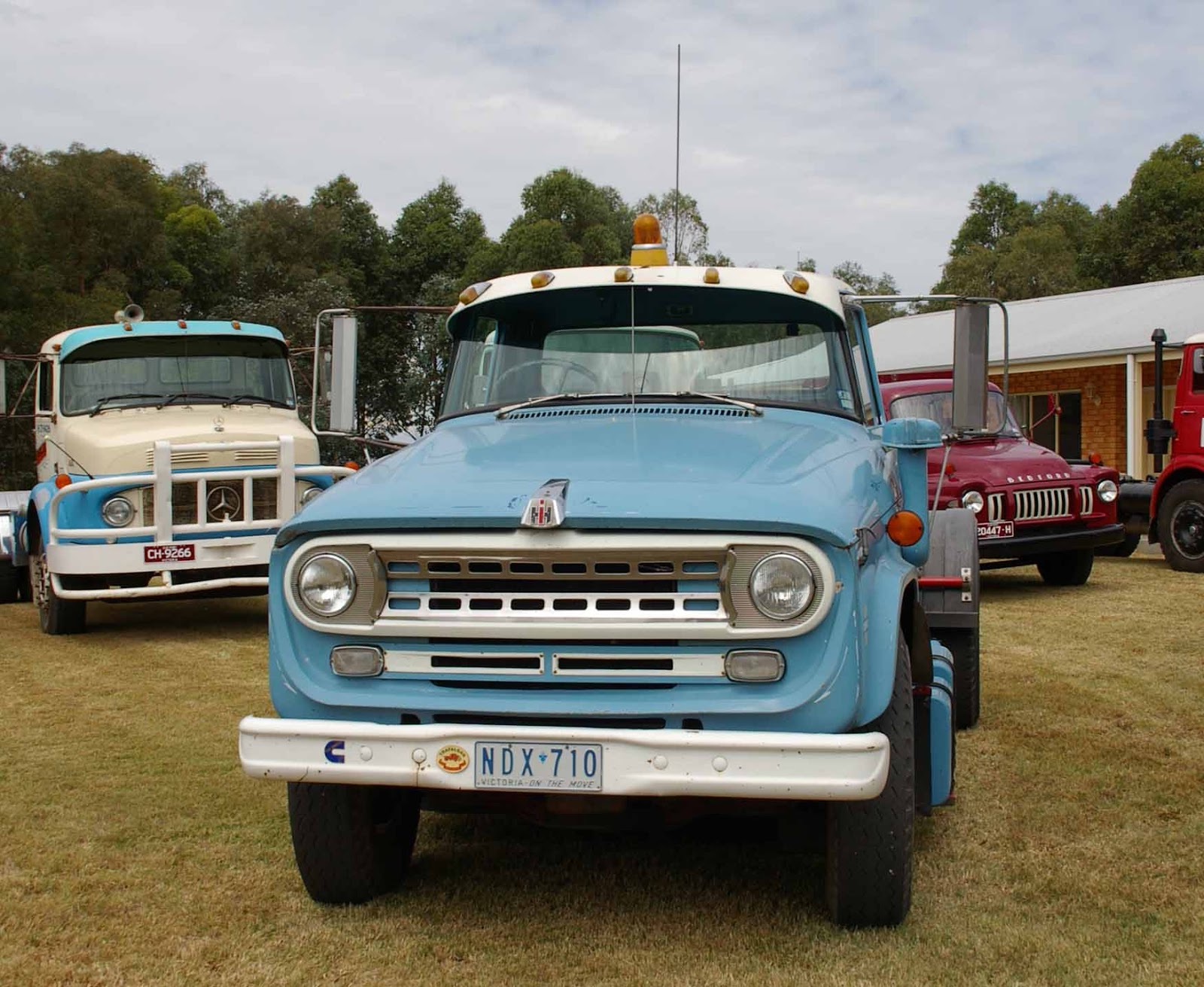

Wayne Henry - 1967 Cummins powered Inter.


Graeme Johnston - 1960 Commer Knocker.


John Denholm - Ford D-series.


Vyn and Chris  Harris - Kenworth S2.


John and Bev Ferguson - 1948 Inter KB3.


Tony and Glenys Hackett - 1957 REO. All the photos in this post are ones I took, apart from this one, as my photo was out of focus. I 'borrowed' this one from Colin Hooks Facebook page.


Click to enlarge all these photos.


Tuesday, November 6, 2012

More Koo-Wee-Rup Swamp machines

In the last post we looked at the Lubecker Steam bucket dredge that worked on the Koo-Wee- Rup Swamp, in this post we will look at other machines. But first - here is a short history of the drainage of the Swamp.  In 1875, landowners on the Swamp formed the Koo-Wee-Rup Swamp Drainage Committee. From 1876 this Committee employed over 100 men and created drains that would carry the water from the Cardinia and Toomuc Creeks to Western Port Bay at Moody’s Inlet. Around the time of the First World War another drain was created to tap the Deep Creek into the Toomuc Drain.  

The Chief Engineer of the Public Works Department, William Thwaites, surveyed the Swamp in 1887 and his report recommended the construction of the Main Drain from where the Bunyip River entered the Swamp in the north to Western Port Bay and a number of smaller side drains.  A tender was advertised in 1889. In spite of strikes, floods and bad weather by March, 1893, the private contractors had constructed the 16 miles of the drain from the Bay to the south of Bunyip. 

Additional drains were added over the years and existing drains were widened and deepened. After the huge 1934 flood that saw the entire Swamp  inundated there was a Royal Commission into the role of the operation of the State Rivers and Water Supply Commission (SRWSC). As a result they worked on new drainage plans for the Swamp which included the construction of the Yallock outfall drain from Cora Lynn, cutting across to Bayles and then essentially following the line of the existing Yallock Creek to Western Port Bay. The aim was to take any flood water directly to the sea so the Main Drain could cope with the remaining water. The Yallock outfall drain was started in 1939 but the works were put on hold during World War 2 and not completed until 1956-57. 

These are SRWSC photographs and show some of the machines that worked on the Swamp in the 1930s and 1940s.


 Deep Creek outfall, No. 15 Dredge. Taken December 1936.


 Sand dredge, Main Drain. December 1936.


 No. 36 excavator, Yallock outfall drain. April 1940.


McGrath's sand dredge, Cardinia Creek. November 1940.


Harmon Excavator working on the Yallock Outfall drain. July 1941.


Yallock Outfall works. December 1947


 Yallock Outfall works. February 1948.


 Yallock Out fall works. Cletrac tractor. February 1948.


No 67 Excavator, remodelling the Little Yannathan Drain. December 1948.

To read about the Lubecker Steam bucket dredge, click here.

Sunday, October 28, 2012

Lubecker Steam Dredge

The Lubecker Steam Dredge was the first machine used on the long running project to drain the Koo-Wee-Rup Swamp. The main drainage work, the construction of the 16 mile long canal or  Main Drain from where the Bunyip River entered the Swamp in the north to Western Port Bay started in 1889 and was finished by March 1893. This work which also included a number a smaller side drains was conceived by Chief Engineer of the Public Works Department, William Thwaites

The Public Works Department engaged Engineer, Carlo Catani, to oversee the continuation of Swamp drainage works in 1893. Catani was keen to introduce land dredges; however this was not approved because it would reduce the work available for unskilled labour. It wasn’t until 1912 that Catani was given permission to purchase a machine and he ordered a Lubecker steam driven bucket dredge from Germany. It was described as being of the articulated ladder type; it ran on rails and had a 9 man crew. It weighed 80 tons and had a capacity of 80 cubic yards per hour or approximately 200,000 cubic yards per annum when working one shift. The purchase price was £2,300 pounds, plus £632 duty. The total cost landed, erected with rails, cranes and other equipment came to £4,716


According to the Lang Lang Guardian the dredge had arrived by June 1913 and was to start work on the Lang Lang River.  From a report in The Argus on October 13, 1915 we can get an idea of how the Dredge operated - it excavates by means of an endless chain arrangement, wherein each link of the chain consists of a heavy steel shovel head…these scrape away the ‘spoil’ and then they deliver it onto a mechanical conveyer …which dumps the earth onto a regular embankment or if necessary into wagons that cart it away. Around August 1916 the Dredge had completed its work on the Lang Lang River, having removed 78,000 cubic yards of earth and creating a channel a mile and half long. It was then taken over by the State Rivers and Water Supply Commission and worked on the Koo-Wee-Rup Swamp on the Main Drain, Cardinia Creek and the Yallock Outfall Drain. 


 Running parallel to the dredge on another set of rails, was a truck powered by a small Tangye engine for the hauling of the machinery and goods.

I believe these photographs could have been taken in 1913, when the Lubecker Dredge first started operating  as there appear to be a lot of men dressed in suits and I don't  believe these ladies would have been employed digging drains!. The photographs are State Rivers & Water Supply Commission photographs are part of the State Library of Victoria collection.

Finally, what happened to the Lubecker Dredge? We don’t know but presumably it was cut up for scrap as all that remains are a set of wheels on display at the Swamp Look-out tower on the South Gippsland Highway, an ignoble end to such a grand machine.

To see other machines such as sand dredges and excavators that worked on the Koo-Wee-Rup Swamp, click here.